
Privacy by Design in Bluetooth Trackers: Build Finding Features with Safety in Mind
蓝牙防丢器的隐私设计:把定位能力与安全边界一起规划
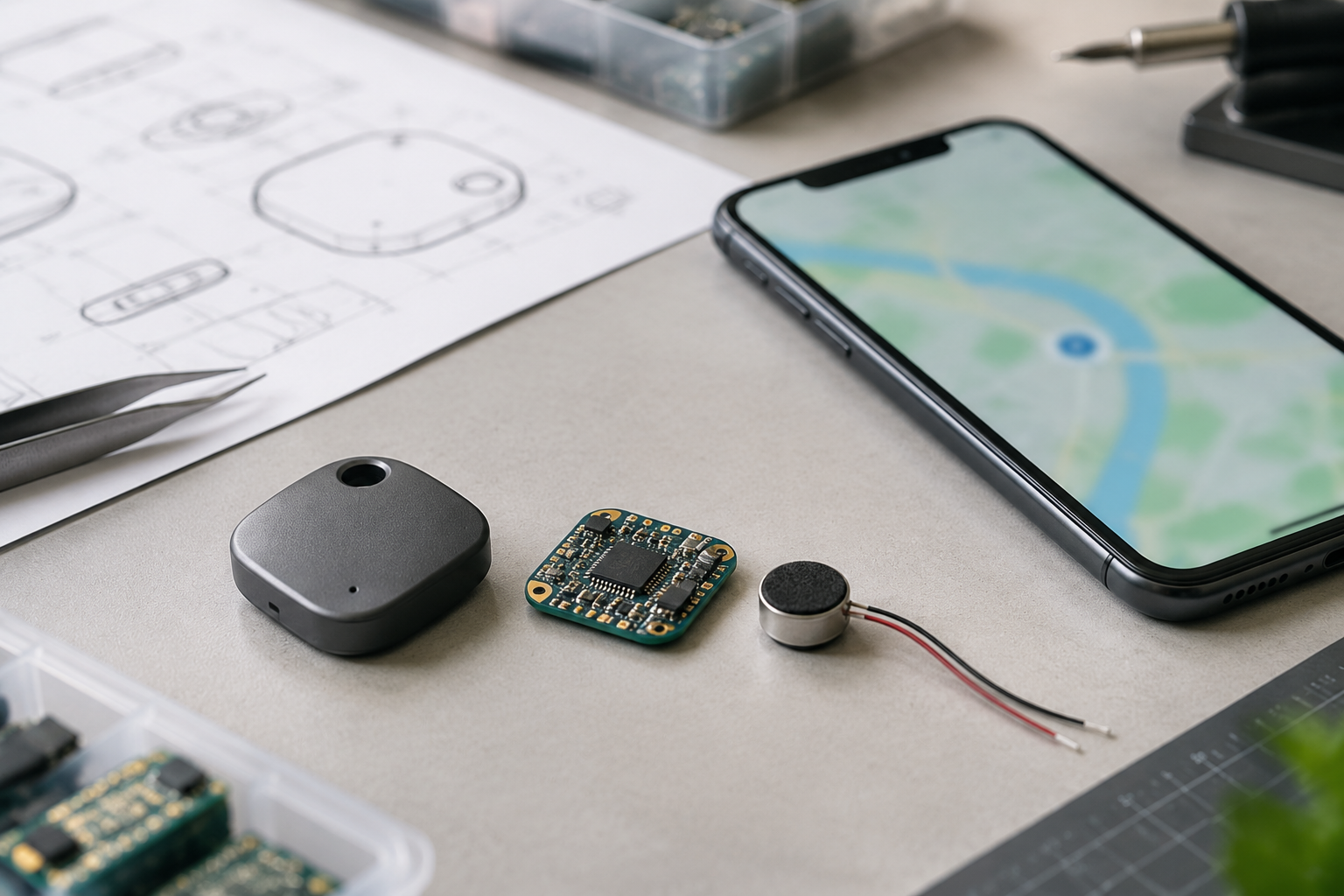
通用蓝牙防丢器工程场景示意图,展示外壳、电路板与声学器件;为本文生成,并非 Stellarrisetech 产品实拍或测试结果。
A Bluetooth tracker is not only a radio beacon. It is a connected product that must help an owner recover an item while reducing the chance of unwanted tracking. Privacy, non-owner controls, sound behavior and reset handling should therefore be part of the product brief from the beginning.
1. Finding performance and safety are the same design conversation
Apple describes the Find My network as a way for users to locate belongings through participating Apple devices, with end-to-end encryption and security protections. Google’s Find Hub documentation likewise explains that participating Android devices can scan for nearby items over Bluetooth and securely send encrypted location information. These systems show why a tracker project must define both the owner experience and the non-owner experience.
2. The broadcast should not become a permanent identity
A practical privacy review asks how the device presents itself over Bluetooth, how identifiers change over time, and which data can be linked to an owner. The goal is not to expose a product’s identity to every nearby observer. Platform specifications and security documentation should be treated as engineering inputs, not as marketing slogans. A hardware team can then review radio behavior, key storage, firmware state changes and server-side assumptions together.
3. Anti-unwanted-tracking behavior needs hardware support
Safety is not completed by an app screen alone. A tracker may need an audible response, a way to enter a non-owner or protection state, and predictable behavior after separation from its owner. Google’s Find Hub accessory specification references the Detecting Unwanted Location Trackers framework and defines dedicated protection-related operations. Apple also emphasizes security and privacy protections for products connected to Find My. The exact implementation depends on the selected platform and the approved technical requirements; it should not be improvised from a generic Bluetooth design.
4. Reset and update flows are part of the product experience
Factory reset, firmware update and ownership transfer are moments when sensitive state can be mishandled. A product brief should specify what keys, pairing records and owner relationships are cleared, what the user must confirm, and how the device behaves if an update is interrupted. This is especially important for OEM and ODM projects, where the enclosure, button, speaker, battery and firmware are often supplied by different workstreams.
5. Turn platform requirements into a manufacturable plan
Stellarrisetech supports OEM, ODM and embedded Bluetooth tracker routes. For a new project, the review can connect industrial design, antenna placement, acoustic output, power strategy, firmware states, certification preparation and production testing. For an existing product, the same checklist helps identify which changes are needed before adding Find My or Find Hub compatibility. The result is a clearer handoff from product brief to samples and repeat orders.
Share the target product, intended platform, form factor, battery model and customization scope through our online inquiry. We can help turn privacy and finding requirements into a practical OEM, ODM or embedded development plan.
Sources
蓝牙防丢器不只是一个无线电信标,它既要帮助物主找回物品,也要降低被用于不必要跟踪的风险。因此,隐私、非物主控制、声音行为和重置处理都应从产品需求阶段纳入规划。
1. 寻物体验与安全边界应当同时讨论
Apple 官方将 Find My 网络描述为一种借助参与网络的 Apple 设备帮助用户查找物品的方式,并强调端到端加密和安全保护。Google 的 Find Hub 资料也说明,参与网络的 Android 设备可以通过蓝牙扫描附近物品,并安全提交加密的位置数据。这说明防丢器项目不能只定义物主如何找回物品,还要定义非物主看到和处理设备时会发生什么。
2. 蓝牙广播不应成为永久身份
隐私评审应关注设备如何通过蓝牙呈现自身、标识符如何随时间变化,以及哪些数据可能与物主建立关联。设计目标不是让附近任何观察者都能识别产品身份。平台规范和安全资料应作为工程输入,而不是营销口号;硬件团队需要把无线行为、密钥存储、固件状态和后台假设放在同一张评审表中。
3. 防止不必要跟踪需要硬件配合
安全功能不能只依赖应用界面。防丢器可能需要可听见的响应、进入非物主或保护状态的机制,以及与物主分离后的可预测行为。Google Find Hub 配件规范引用了 Detecting Unwanted Location Trackers 框架,并定义了与保护功能相关的操作;Apple 也强调接入 Find My 的产品需要重视安全和隐私。具体实现取决于所选平台及其适用技术要求,不能从普通蓝牙设计中自行臆造。
4. 重置与更新流程同样属于产品体验
恢复出厂、固件更新和所有权转移都是敏感状态容易被误处理的环节。产品需求应明确哪些密钥、配对记录和物主关系需要清除,用户需要确认什么,以及更新中断时设备如何处理。对于 OEM 和 ODM 项目,这一点尤其重要,因为外壳、按键、扬声器、电池和固件往往由不同工作流共同完成。
5. 把平台要求转化为可量产方案
Stellarrisetech 提供 OEM、ODM 和嵌入式蓝牙防丢器路线。新项目可以把工业设计、天线布局、声学输出、电源策略、固件状态、认证准备和生产测试连接起来;已有产品则可通过同一清单判断,在增加 Find My 或 Find Hub 兼容性前需要完成哪些调整。这样能让产品需求更清晰地衔接到样品验证和稳定量产。
欢迎通过在线询盘提交目标产品、平台、外形、电池型号和定制范围,我们可以协助将隐私与寻物要求落实为可执行的 OEM、ODM 或嵌入式开发计划。