
STELLARRISETECH / INDUSTRY NEWS
Bluetooth Channel Sounding for Tracker Design: From Distance Awareness to OEM Validation
蓝牙信道探测与防丢器设计:从距离感知到 OEM 验证
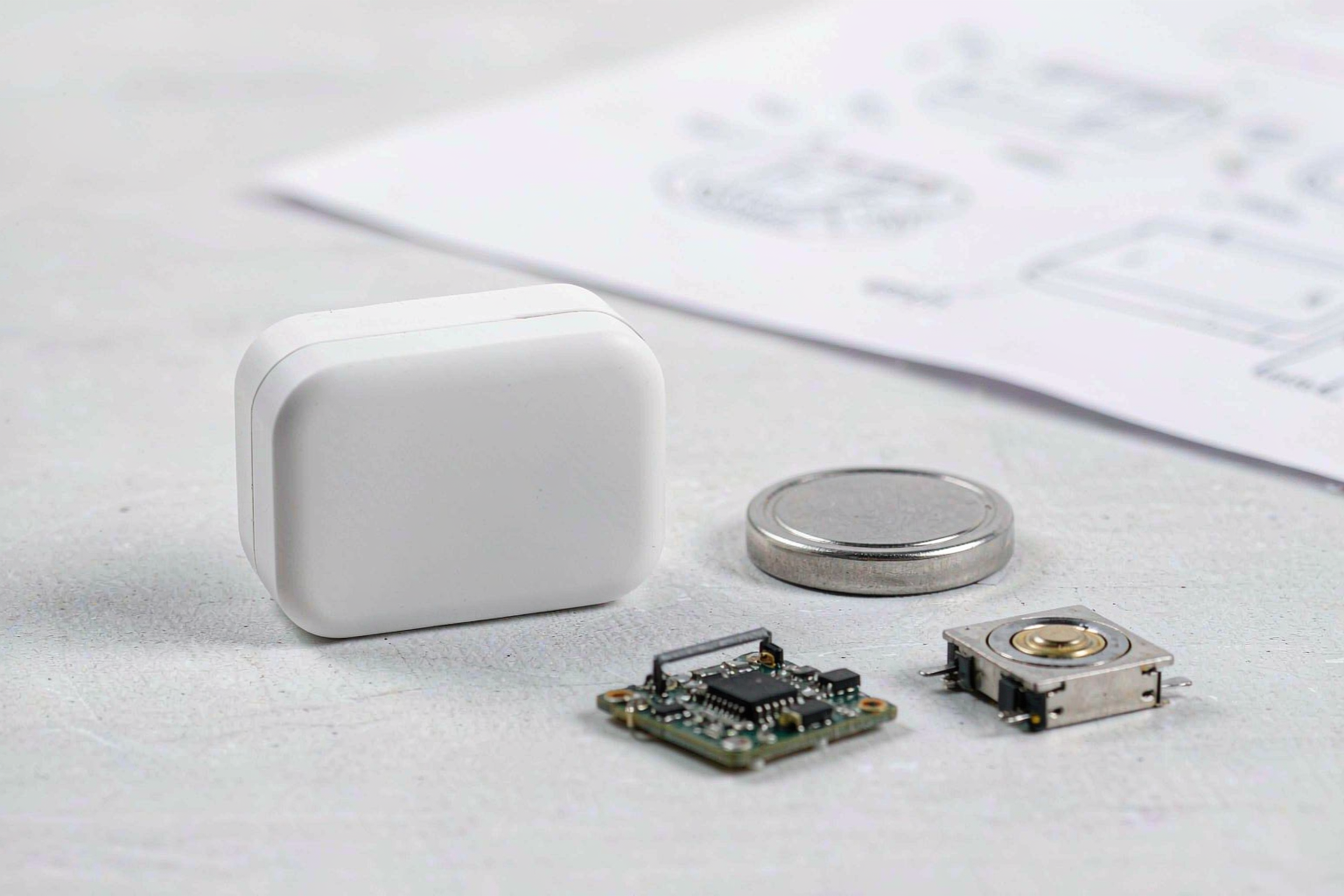
无品牌防丢器硬件、电池与声学部件主题示意图;并非 Stellarrisetech 产品实拍、认证结果或性能测试照片。
ENGLISH ARTICLE
Distance awareness is a product architecture decision, not a checkbox. Bluetooth Low Energy tracker projects have traditionally separated presence, last-seen reporting and distance estimation. Bluetooth Channel Sounding adds a standardized direction for fine ranging, but the feature still depends on compatible endpoints, antenna and RF design, firmware, algorithms, power planning and validation conditions.
1. What Channel Sounding changes
Bluetooth SIG describes Bluetooth Channel Sounding as two distance-measurement methods: Phase-Based Ranging (PBR) and Round-Trip Timing (RTT). They may be used independently or together. The official overview positions the feature as a more sophisticated alternative to path-loss calculations based mainly on received signal strength, with security mechanisms and reduced sensitivity to some environmental factors.
This does not mean every Bluetooth tracker automatically becomes a precision-finding product. Channel Sounding takes place between two connected devices in a one-to-one topology. The application still has to turn controller measurements into a distance estimate, and the practical experience depends on support at both endpoints.
2. Why this matters for tracker planning
A crowded product brief often treats “Bluetooth tracking” as one capability. In practice, the user experience may include at least four layers: detecting a nearby advertisement, receiving a network-assisted location report, playing an acoustic alert, and estimating distance during a local finding interaction. These layers use different assumptions and should not be presented as one guaranteed accuracy number.
For a new tracker, the first decision is therefore not “add the newest radio feature.” It is “which finding interaction must be reliable?” A project that needs a last-seen clue may prioritize battery life, enclosure constraints and ecosystem compatibility. A project that needs local distance awareness may need a compatible phone or gateway, suitable antenna paths, additional firmware work and a controlled validation plan.
3. The engineering variables behind the experience
- Endpoint support: confirm that the intended phone, module or gateway supports the relevant Bluetooth capability and software path. Do not assume that a capable controller guarantees a finished user-facing feature.
- RF and antenna design: review antenna placement, enclosure materials, ground clearances and nearby battery or metal parts. Channel Sounding measurements are still radio measurements, so the mechanical design can influence the result.
- Power budget: define when the device advertises, connects, performs ranging exchanges and drives the buzzer. Separate the energy cost of an occasional local interaction from the budget for a long standby life.
- Algorithm and acceptance criteria: specify how raw measurements become a displayed distance, how outliers are handled and which environments are included. A lab demonstration is not the same as a repeatable product requirement.
4. Keep network finding and local ranging separate
Google explains that Find Hub can use nearby participating Android devices to report where an item was detected and approximately when it was last seen. Apple similarly documents network-assisted offline finding for compatible devices and accessories. These network observations are valuable recovery clues, but they are not the same as a continuous live position or a local distance measurement.
For product documentation, keep the terms distinct: “network location” describes an ecosystem-assisted observation; “nearby finding” describes a local interaction; “distance awareness” describes an estimate produced under supported conditions. Clear language reduces the risk of turning an ecosystem feature into an unsupported product promise.
5. A practical OEM, ODM and embedded validation brief
A useful project brief can be organized into five questions:
- Which ecosystem and endpoint combinations must be supported?
- Is the primary user need last-seen recovery, nearby sound, direction, distance, or a staged combination?
- What are the target form factor, battery, acoustic output and enclosure constraints?
- Which environments represent real use: open space, indoor rooms, metal surfaces, bags or vehicles?
- What will be measured, how many repetitions are needed, and what result is acceptable?
Stellarrisetech publicly presents OEM ready-to-brand trackers, ODM custom tracker development and embedded tracking solutions. For an actual project, the appropriate route depends on the intended product, quantity, customization scope and the engineering evidence required before production handoff. No platform feature should be treated as a substitute for a product-specific validation plan.
Turn distance awareness into a testable product decision.
Share your target ecosystem, phone or gateway assumptions, product format, battery expectations, carrying scenario and customization scope to discuss an OEM, ODM or embedded route.
中文文章
距离感知是产品架构决策,而不是一个简单的功能勾选项。 传统蓝牙低功耗防丢器项目,通常会把附近发现、最后发现位置上报和距离估算分开考虑。蓝牙信道探测为精细测距提供了标准化方向,但实际效果仍取决于兼容终端、天线与射频设计、固件、算法、电源规划和验证条件。
1. 信道探测改变了什么
Bluetooth SIG 将蓝牙信道探测描述为两种距离测量方法:基于相位的测距(PBR)和往返时间(RTT)。两者可以单独使用,也可以结合使用。官方概览将该功能定位为比主要依靠接收信号强度的路径损耗计算更成熟的方案,并介绍了相关安全机制以及对部分环境因素敏感度降低的特点。
但这并不意味着所有蓝牙防丢器都会自动变成精准查找产品。信道探测发生在两个已连接设备之间,采用一对一拓扑。应用仍需要把控制器测量结果转化为距离估算,而最终体验还取决于通信两端是否都提供相应支持。
2. 为什么这会影响防丢器规划
很多产品需求会把“蓝牙追踪”视为一种单一能力。实际上,用户体验至少可能包括四个层次:发现附近广播、接收网络辅助位置报告、播放声学提示,以及在近距离查找时估算距离。这些层次的前提不同,不应被包装成一个保证准确度的数字。
因此,新防丢器的第一个问题不是“要不要加入最新无线功能”,而是“哪一种查找体验必须稳定”。如果项目主要需要最后发现位置线索,应重点规划电池寿命、外壳限制和生态兼容性。如果项目需要本地距离感知,则可能还需要兼容的手机或网关、合适的天线路径、额外固件工作以及受控的验证计划。
3. 体验背后的工程变量
- 终端支持:确认目标手机、模块或网关是否支持相关 Bluetooth 能力和软件路径。控制器具备能力,不等于已经形成完整的用户功能。
- 射频与天线设计:检查天线位置、外壳材料、净空区域,以及电池或金属部件的邻近影响。信道探测本质上仍是无线测量,因此机械设计可能影响结果。
- 电源预算:分别定义设备广播、建立连接、执行测距交互和驱动蜂鸣器时的功耗。偶尔一次的近距离交互,与长期待机所需的电源预算,应分开计算。
- 算法和验收标准:明确原始测量如何转化为界面距离、如何处理异常值,以及纳入哪些环境。实验室演示不等于可重复的产品需求。
4. 把网络查找与本地测距分开
Google 说明,Find Hub 可以利用附近参与网络的 Android 设备,报告物品被检测到的位置以及大致的最后发现时间。Apple 也对兼容设备和配件的网络辅助离线查找进行了说明。这些网络观察结果可以成为找回物品的重要线索,但不等同于持续实时位置,也不等同于本地距离测量。
在产品资料中,应保持术语边界清晰:“网络位置”描述生态网络辅助的观察记录;“附近查找”描述本地交互;“距离感知”描述在受支持条件下产生的估算。清楚的表述有助于避免把生态功能扩大为未经验证的产品承诺。
5. OEM、ODM 与嵌入式项目的实用验证需求
一份有用的项目需求,可以围绕以下五个问题组织:
- 需要支持哪些生态和终端组合?
- 用户的主要需求是最后发现位置、附近响铃、方向、距离,还是分阶段组合?
- 目标产品形态、电池、声学输出和外壳有哪些限制?
- 哪些环境代表真实使用:开放空间、室内房间、金属表面、包内或车辆内?
- 具体测量什么、需要重复多少次、什么结果才算可接受?
Stellarrisetech 官网公开介绍了可定牌 OEM 防丢器、ODM 定制开发和嵌入式追踪方案。实际项目应根据产品方向、预期数量、定制范围以及量产交接前需要的工程证据来选择路线。任何平台功能都不能替代针对具体产品制定的验证计划。
Public sources / 公开资料
- Bluetooth SIG — Bluetooth Core 6.0 feature overview
- Apple — Find My security
- Google — How Find Hub protects your data
- Stellarrisetech — OEM, ODM and embedded service overview
Prepared from public documentation and the company’s public service pages, checked on 7 October 2026. Platform capabilities, endpoint support and product performance vary by implementation and conditions. This article does not certify any specific accessory or promise a guaranteed distance, range or update interval.
本文依据公开技术资料和公司公开服务页面独立组织撰写,资料核对日期为 2026 年 10 月 7 日。平台能力、终端支持和产品性能会因实现方式与使用条件而变化。本文不代表任何具体配件获得认证,也不承诺固定距离、范围或更新间隔。