
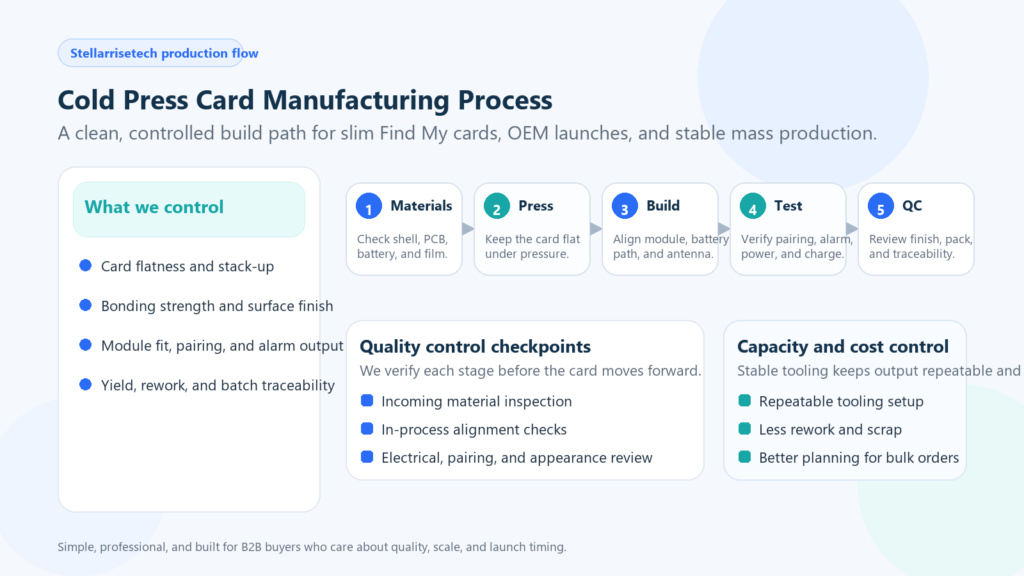
The cold press card manufacturing process is how Stellarrisetech turns a thin tracker card into a reliable, production-ready product. When we build a Find My card, we are not just chasing a slim profile. We are balancing flatness, bonding strength, antenna performance, battery protection, and repeatable output from sample to mass production.
Why the cold press card manufacturing process matters
A tracker card looks simple from the outside, but the production logic is not simple at all. A thin shell leaves very little room for error. If the stack-up is off, the card can warp, the module can shift, or the finish can look uneven. That is why we treat the cold press card manufacturing process as an engineering discipline, not a cosmetic step.
For the end user, the experience should feel effortless. Apple describes the Find My experience on Apple’s official Find My page, and Google offers a similar user path through Google’s Find Hub and Find My Device experience. Our job is to make the hardware behind that experience thin, durable, and stable.
If you want to see the product family this process supports, start with our Find My Card -01. That product reflects the same design logic we use in production: slim form, practical function, and consistent quality.
The cold press card manufacturing process in five steps
We keep the build path clear so the team on the line can control quality at each stage. That also makes the process easier to scale, because every station has a clear job and a clear pass or fail result.
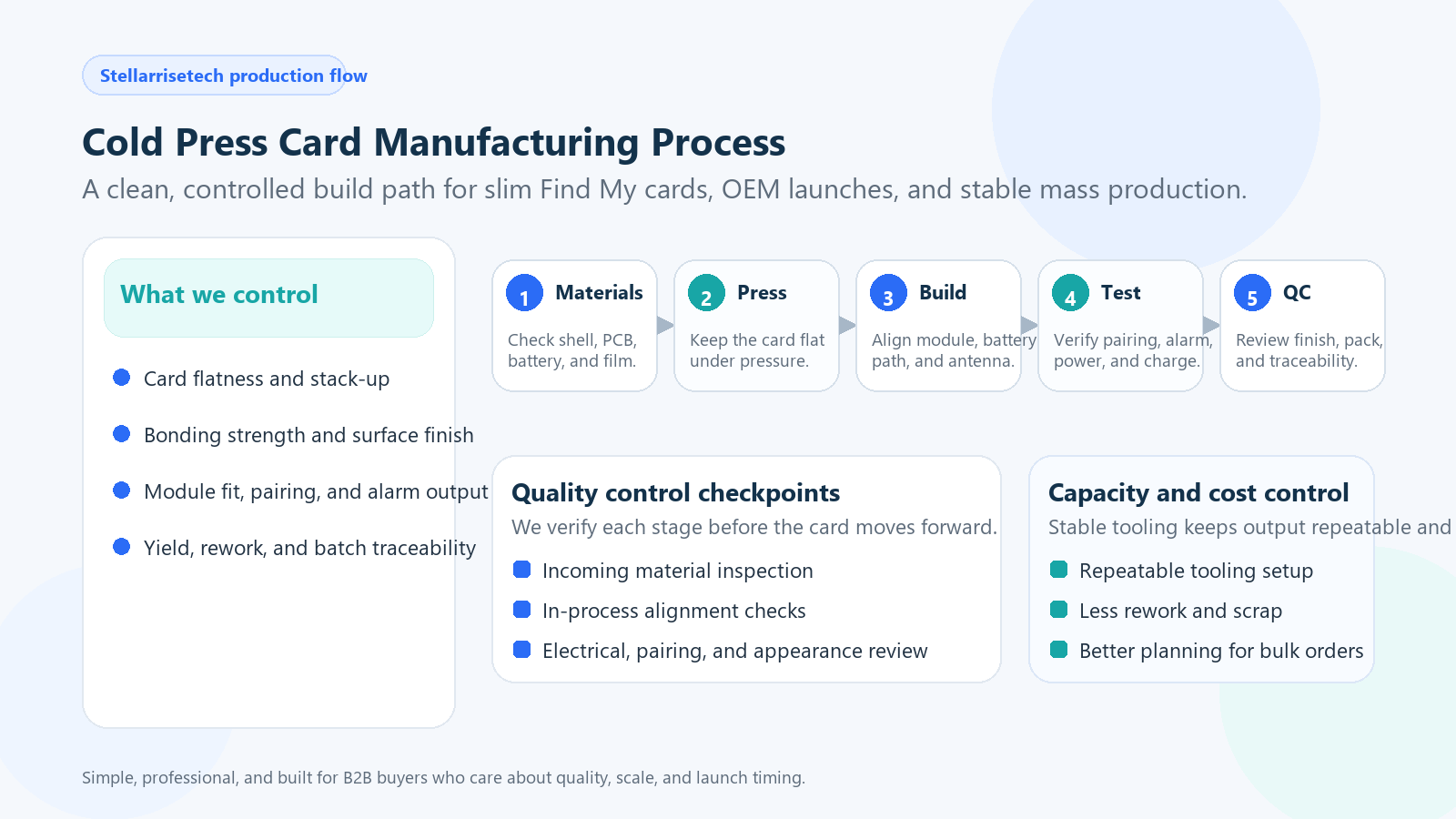
- Materials and stack-up control. We verify the shell, PCB, battery, film, and adhesive before production begins. Thickness, flatness, and fit all matter here.
- Cold pressing and lamination. The card body is formed under controlled pressure so the finished part stays flat and consistent. This step protects both appearance and assembly accuracy.
- Module assembly. We align the tracker module, battery path, and antenna. Good alignment reduces interference and helps keep pairing behavior stable.
- Functional testing. Each unit is checked for pairing, alarm output, power behavior, and charging performance. A slim card still has to work like a dependable tracker.
- Final inspection and packing. We review appearance, packaging, and traceability before shipment. That final gate protects brand reputation and lowers avoidable returns.
Quality control is built into the line
At Stellarrisetech, quality control starts before a card is pressed and continues until the carton is sealed. We do not wait until the end of the line to discover a problem. Instead, we use checkpoints that catch variation early, while the fix is still inexpensive and fast.
Incoming material inspection helps us catch shell defects, adhesive problems, or inconsistent batch quality. In-process checks keep the card within tolerance while the stack is being formed. Electrical and appearance checks confirm that the product still looks clean after assembly and still performs properly after handling.
This approach also supports better traceability. When we know which batch, fixture, and test result belongs to each run, we can diagnose issues faster and protect the customer from repeat problems. That is a practical advantage, especially for OEM and ODM projects that need stable launch timing.
Capacity and cost control without sacrificing quality
Capacity matters because buyers do not just want a good sample. They want a product that can move from pilot builds to bulk production without a major process change. Our cold press card manufacturing process is designed for that transition. Stable tooling and repeatable steps make it easier to plan labor, line balance, and shipping windows.
Cost control also matters, but we do not treat it as a race to the lowest possible material spend. Real cost control comes from reducing scrap, reducing rework, and reducing hidden variation. When the stack-up is right and the testing plan is clear, the factory spends less time correcting preventable mistakes.
That is why we focus on process stability first. A stable process is usually the cheapest process over time, because it protects yield and keeps the launch plan from slipping.
Why Stellarrisetech
We support more than one product path, so the same production discipline can serve different market goals. If you need a private-label launch, our OEM Services page explains how we support brand-specific builds. If you need a deeper product-development partnership, our ODM Services page shows how we move from concept to commercial production.
For buyers planning a wider ecosystem strategy, our Dual System direction shows how one hardware platform can support different user environments. That matters when a customer wants a product line that can grow across markets without losing manufacturability.
In short, our cold press card manufacturing process is built to support product quality, production scale, and brand credibility at the same time. That combination is what most buyers really need.
Let’s build your next card
If you are planning a Find My card, a dual-system tracker card, or a private-label B2B launch, Stellarrisetech can support the path from design to mass production. We can help you align tooling, process control, and test requirements before the first bulk order goes out.
For partners who want a slim tracker card with stable output and disciplined cost control, this is the kind of process that keeps the program moving. If that is your goal, we are ready to help.