
STELLARRISETECH / INDUSTRY NEWS
双系统防丢器规划:把生态兼容与产品配置分开定义
ENGLISH ARTICLE
Dual-System Tracker Planning: Separate Ecosystem Compatibility from Product Configuration
A dual-system tracker is not defined by a label alone. Separate ecosystem eligibility, hardware and firmware configuration, user setup, and validation evidence before turning an OEM or embedded concept into a product brief.
1. Start with the two ecosystem routes, not the word dual-system
Apple Find My and Google Find Hub each have their own accessory requirements, user flows and privacy protections. Apple describes Find My as a network in which nearby devices can detect Bluetooth signals and relay an approximate location securely. Google describes Find Hub as an opt-in Android device network that uses Bluetooth detection and encrypted location reporting. These descriptions explain the network concepts; they do not prove that one accessory is automatically eligible for both ecosystems. [1][2]
Before requesting a quotation, write the intended route as a product decision: Apple Find My, Google Find Hub, or a product family with separately configured variants. Record which phone operating systems, setup steps and user-facing compatibility statements are in scope. Do not treat a future roadmap, a laboratory scan or a generic Bluetooth connection as evidence of platform compatibility.
2. Turn the route into a configuration matrix
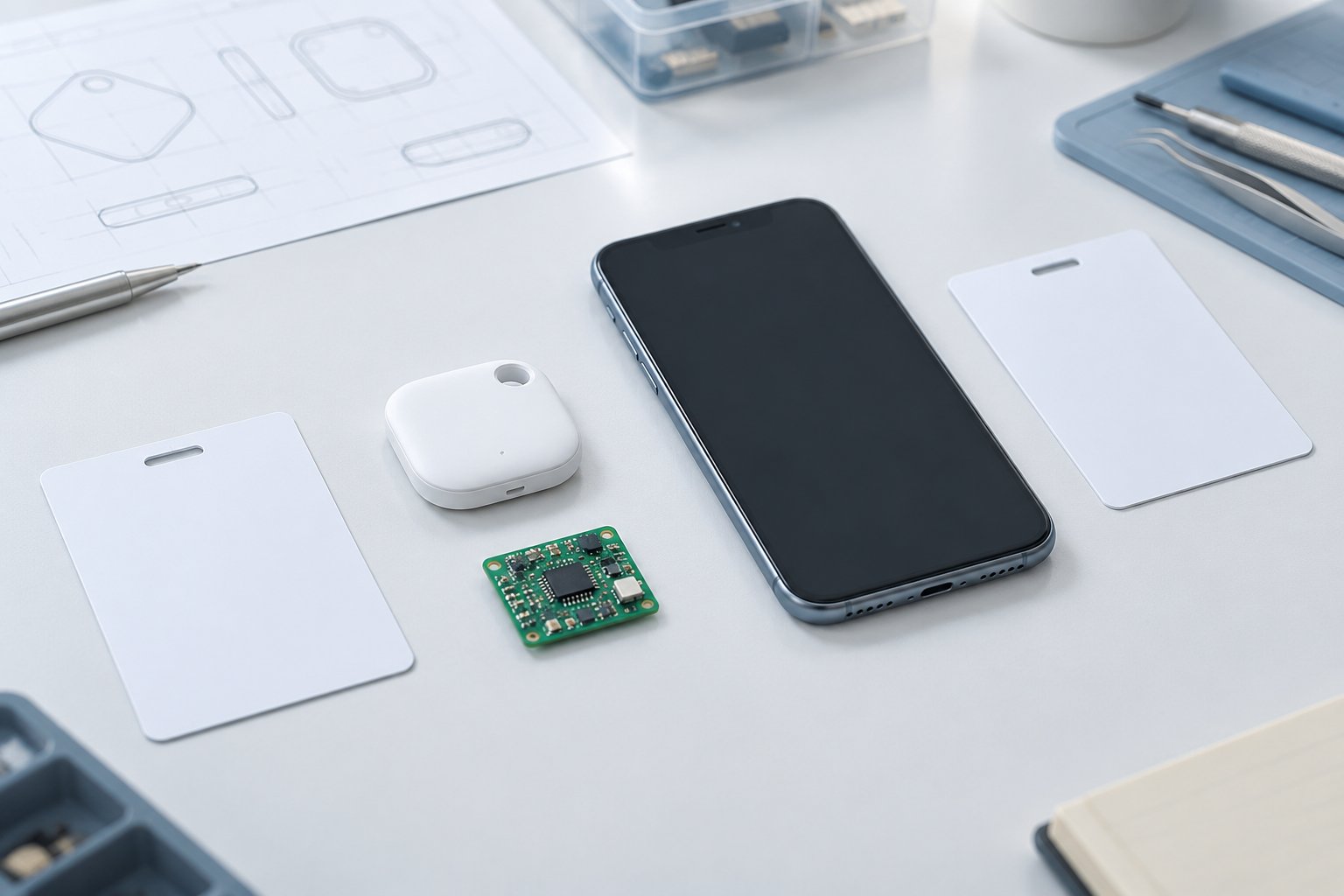
A useful matrix has at least four layers: ecosystem route, radio and firmware configuration, physical product format, and customer-facing setup. The same shell concept may be suitable for a tag, card or embedded module, but the antenna placement, battery choice, sound path, button or reset design and firmware behaviour still need product-specific decisions.
For each proposed SKU, list what is shared and what is different. Shared items might include enclosure tooling, packaging structure or production inspection. Route-specific items may include firmware configuration, onboarding instructions, platform wording and the test evidence required before the item can be described as compatible. This prevents a sales sheet from collapsing several different engineering assumptions into one sentence.
3. Separate platform evidence from Bluetooth evidence
A successful Bluetooth scan or connection answers a narrow radio question. It does not by itself demonstrate account onboarding, network-assisted finding, privacy behaviour, unknown-tracker protections or the exact user flow of an ecosystem. Likewise, a product page that displays a compatibility phrase is not a substitute for checking the applicable platform documentation and the product's actual configuration.
Build the validation record in layers: basic electrical and radio checks; local discovery and sound interaction where supported; onboarding and account-state checks; network-assisted finding in an authorised test setup; and recovery, reset or ownership-transfer checks. Label each observation precisely and keep failed trials. Internal acceptance criteria are project controls, not automatically platform certification thresholds.
4. Treat privacy and safety as product requirements
Apple and Google both describe privacy and safety mechanisms around network-assisted finding and unknown-tracker awareness. These mechanisms affect how a product is introduced, tested and supported. A dual-system brief should therefore include consent, account ownership, lost-item handling, reset, deactivation and support escalation—not only range, battery or enclosure dimensions. [1][2]
Avoid wording that suggests a tracker can be used to monitor people without their knowledge. Test documents should use consenting participants and controlled items, and should explain what information is actually observable. A clear limitation is part of a credible product specification, not a weakness to hide.
5. Hand off one evidence-backed brief to production
Stellarrisetech publicly presents OEM private-label manufacturing, ODM custom tracker development and embedded tracking hardware. Those routes can be evaluated against the same structured brief: target ecosystem, product form, quantity range, customization scope, firmware responsibility, validation plan and launch documentation. The website's service description does not by itself certify a specific SKU or platform result. [3]
The strongest handoff keeps the product name, packaging, setup guide, test report and support answers aligned. State exactly which ecosystem route was validated, under which configuration and conditions, and which items remain open. That discipline makes a dual-system concept easier to quote, sample, test and scale without turning an unverified compatibility assumption into a market promise.
Define the ecosystem route before promising the product experience.
Share your target ecosystems, tracker format, quantity range, firmware responsibility and validation scope to discuss an OEM, ODM or embedded tracking project.
中文文章
双系统防丢器规划:把生态兼容与产品配置分开定义
双系统防丢器不能只用一个标签定义。在把 OEM 或嵌入式概念写成产品需求前,应分别明确生态适配条件、硬件与固件配置、用户设置以及验证证据。
1. 先拆分两条生态路线,而不是只写“双系统”
Apple Find My 和 Google Find Hub 各自拥有配件要求、用户流程和隐私保护机制。Apple 说明,Find My 网络中的附近设备可以检测蓝牙信号,并以安全方式转发大致位置。Google 说明,Find Hub 是由用户选择参与的 Android 设备网络,通过蓝牙检测和加密的位置上报发挥作用。这些说明解释了网络查找的基本概念,但不能证明一款配件会自动同时具备两种生态的适配资格。[1][2]
在询价前,应把目标路线写成产品决策:Apple Find My、Google Find Hub,或由分别配置的型号组成产品家族。同时记录目标手机操作系统、设置步骤和面向用户的兼容性表述。不要把未来路线图、实验室扫描结果或普通蓝牙连接,当成平台兼容性的证据。
2. 把路线转化为配置矩阵
一份实用的配置矩阵,至少应包含四层:生态路线、无线与固件配置、产品物理形态,以及面向客户的设置流程。同一个外壳概念可能适用于标签、卡片或嵌入式模块,但天线位置、电池选择、发声路径、按键或复位设计和固件行为,仍需逐项作出产品决定。
针对每个拟议 SKU,应列出哪些内容共用、哪些内容不同。外壳模具、包装结构或生产检验可能是共用项;固件配置、引导说明、平台措辞和描述为兼容产品前所需的测试证据,则可能是路线特定项。这样可以避免在销售资料中把多个工程假设压缩成一句话。
3. 将平台证据与蓝牙证据分开
一次成功的蓝牙扫描或连接,只能回答有限的无线问题。它本身不能证明账号引导、网络辅助查找、隐私行为、不明防丢器保护或某一生态的完整用户流程。同样,产品页面出现兼容性措辞,也不能替代对适用平台文档和产品实际配置的核对。
验证记录应分层建立:基础电气与无线检查;在受支持条件下验证近距离发现和声音交互;验证引导流程与账号状态;在获授权的测试环境中验证网络辅助查找;再验证恢复、复位或所有权转移。每项观察都应准确命名,并保留失败试验。内部验收标准是项目控制要求,不会自动等同于平台认证门槛。
4. 把隐私与安全作为产品要求
Apple 和 Google 都介绍了网络辅助查找及不明防丢器提醒相关的隐私与安全机制。这些机制会影响产品如何导入、测试和提供支持。因此,双系统需求书不应只写距离、电池或外壳尺寸,还应包含知情同意、账号所有权、失物处理、复位、停用和支持升级流程。[1][2]
应避免使用暗示可以在他人不知情的情况下监控他人的表述。测试文件应使用知情同意的参与者和受控物品,并说明实际能够观察到哪些信息。清楚写出限制,是可信产品规格的一部分,而不是需要掩盖的弱点。
5. 用一份有证据支撑的需求书交接生产
Stellarrisetech 官网公开介绍了 OEM 定牌制造、ODM 防丢器定制开发和嵌入式追踪硬件。这些路线可以用同一份结构化需求书进行评估:目标生态、产品形态、数量范围、定制深度、固件责任、验证计划和上市资料。官网服务说明本身并不能证明某个 SKU 或平台结果已经获得认证。[3]
高质量的生产交接,应让产品名称、包装、设置指南、测试报告和支持答复保持一致。应准确写明已在哪一条生态路线、何种配置和何种条件下完成验证,以及哪些项目仍未关闭。这样,双系统概念才更容易完成报价、打样、测试和量产,而不会把未经验证的兼容性假设变成市场承诺。
Public sources / 公开资料
- Apple Platform Security — Find My security
- Google Android — Find Hub
- Stellarrisetech — Bluetooth Tracker Product Lines
Public documentation checked on 18 October 2026. Independently written guidance; internal test suggestions are not platform certification requirements. No model-specific performance or certification is claimed.
公开资料核对日期:2026 年 10 月 18 日。本文独立撰写;内部测试建议并非平台认证要求,未宣称任何具体型号的性能或认证状态。