
Bluetooth Tracker Certification Readiness: Turn the Product Brief into a Verifiable Checklist
蓝牙定位器认证准备:把产品需求转化为可验证清单
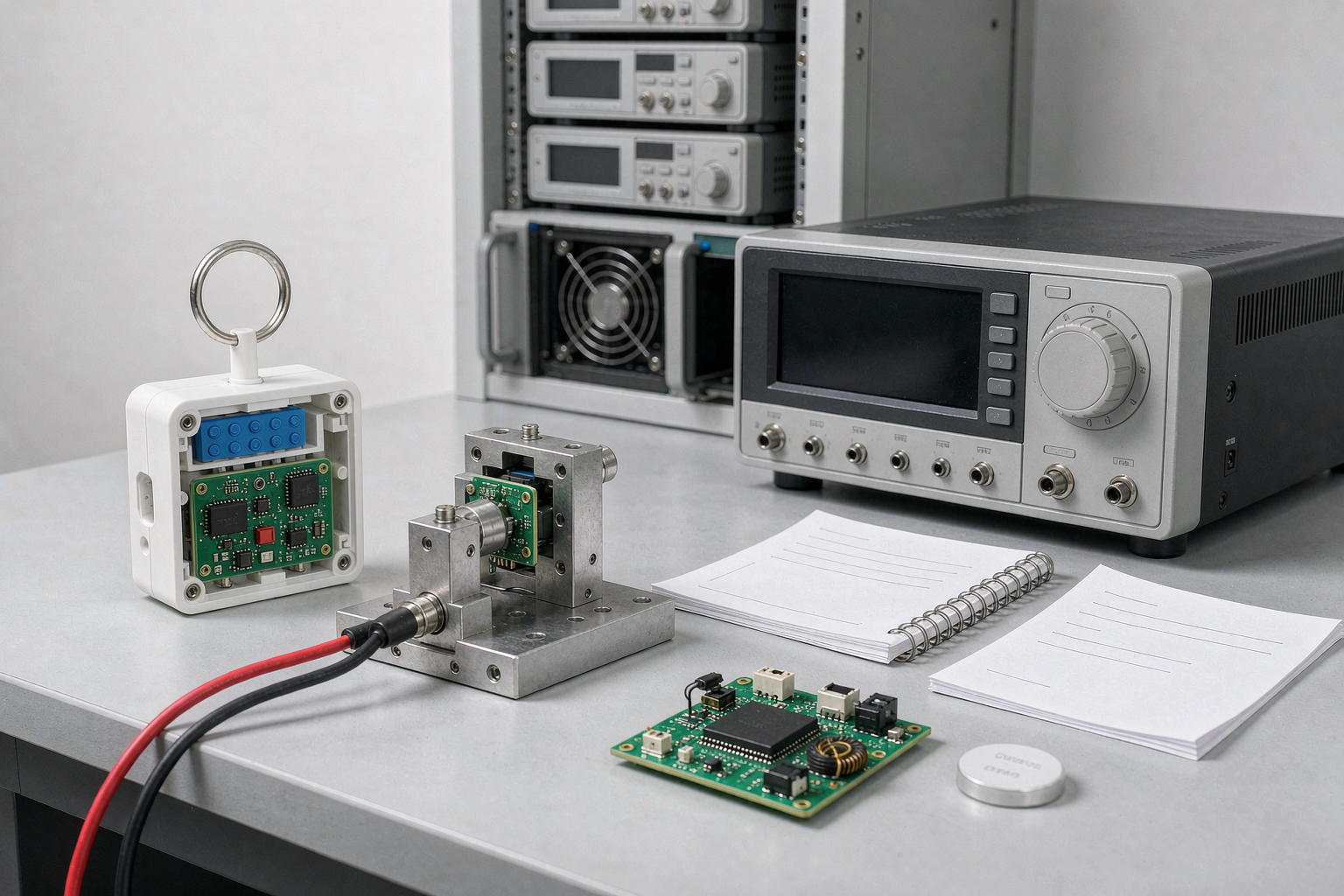
蓝牙定位器验证场景示意图,展示样机、PCBA、天线、电池和测试设备;为本文生成的说明性图片,并非 Stellarrisetech 产品实拍或测试结果。
A tracker project becomes easier to control when platform requirements are translated into checks that can be observed, recorded and repeated. Certification is not proven by a working Bluetooth advertisement alone; the assembled product, firmware, user flow and safety behavior all need a defined review path.
1. Start with the platform boundary
Apple states that developers and manufacturers connecting an existing or new accessory to the Find My network should enroll in the MFi Program to access the technical specifications and resources needed to create the product. Google’s Locator Tags requirements reference the relevant Fast Pair specification, Find Hub Network specification and unwanted-tracking-prevention behavior for certification. These platform boundaries should be written into the product brief before hardware details are frozen.
2. Convert requirements into observable checks
A useful checklist separates what the team must demonstrate from what it merely intends to support. Pairing and advertising should be checked on the assembled sample. Antenna behavior should be reviewed with the final enclosure and nearby materials. Battery access, sound output, firmware state changes and user-facing flows should be recorded with clear pass conditions. A check is stronger when the test setup, sample state, expected result and evidence location are written down.
3. Review the whole assembled product
Radio performance can change after tooling, coating, adhesive, battery placement or a change in the enclosure wall. For that reason, a bare PCBA result should not be treated as a finished-product result. The validation loop should include the shell, PCBA, antenna, battery, firmware and intended carrying position. Repeating the same checks after a design revision also makes engineering decisions easier to compare.
4. Treat privacy and anti-tracking as product behavior
Platform connectivity is only one part of a responsible tracker design. Apple highlights end-to-end encryption and privacy protection for the Find My network, while Google’s Locator Tags documentation includes unwanted-tracking prevention requirements. The project brief should therefore assign owners and evidence for user notices, alert behavior, reset or ownership transitions and the relevant platform test results. This is a product and compliance workflow, not a marketing claim.
5. A practical handoff to manufacturing
Before manufacturing handoff, consolidate the product brief, revision-controlled drawings, firmware version, test fixtures, sample records and quality checkpoints. Stellarrisetech’s ODM route defines the target user, environment, platform and business goal, then plans structure, PCBA, firmware, packaging and sample direction before validating pairing, antenna, battery, assembly, reliability and user flow. A clear evidence package helps the next team understand what was tested and what remains open.
Share the target ecosystem, form factor, carrying environment, quantity and customization scope with Stellarrisetech for an OEM, ODM or embedded route review.
当平台要求被转化为可观察、可记录、可重复的检查项目时,定位器项目会更容易控制。蓝牙信号能够正常广播,并不能单独证明产品已经满足认证要求;整机、固件、用户流程和安全行为都需要明确的评审路径。
1. 先明确平台边界
Apple 说明,开发者和制造商如要让现有或新配件接入 Find My 网络,应加入 MFi 计划,以获得创建产品所需的技术规范和资源。Google 的 Locator Tags 要求则引用了相关 Fast Pair 规范、Find Hub 网络规范以及不必要跟踪防护行为,并将其纳入认证要求。产品需求书应在硬件细节冻结之前写清楚这些平台边界。
2. 把要求转化为可观察检查
一份有效的检查清单,应区分“必须证明的内容”和“计划支持的功能”。应在整机样机上检查配对和广播,在最终外壳及周边材料状态下评审天线表现,同时记录电池维护、声音输出、固件状态变化和用户操作流程。测试设置、样机状态、预期结果和证据存放位置越明确,检查结果越可靠。
3. 评审完整装配产品
开模、涂层、胶粘剂、电池位置或外壳壁厚变化,都可能改变无线表现。因此,裸 PCBA 的结果不能直接当作成品结果。验证循环应包含外壳、PCBA、天线、电池、固件和预期携带位置。设计修改后重复同一套检查,也能让工程团队更容易比较不同方案。
4. 把隐私和防跟踪当作产品行为
平台接入只是负责任定位器设计的一部分。Apple 强调 Find My 网络的端到端加密和隐私保护,Google 的 Locator Tags 文档也包含不必要跟踪防护要求。因此,项目需求应为用户提示、提醒行为、重置或所有权转换以及平台测试结果分别指定负责人和证据。这是一套产品与合规流程,而不是营销承诺。
5. 为量产移交准备完整资料
在移交制造之前,应整理产品需求、受控版本图纸、固件版本、测试夹具、样机记录和质量检查点。Stellarrisetech 的 ODM 流程先明确目标用户、环境、平台和业务目标,再规划结构、PCBA、固件、包装及样机方向,之后验证配对、天线、电池、装配、可靠性和用户流程。清晰的证据包能帮助下一阶段团队了解已经验证的内容和仍待关闭的问题。
可以向 Stellarrisetech 提供目标生态、产品外形、携带环境、数量及定制范围,评估 OEM、ODM 或嵌入式方案。
Public sources / 公开来源
- Apple Developer — Find My network
- Google for Developers — Locator Tags
- Stellarrisetech — Custom Bluetooth Tracker ODM
本文为独立组织的行业科普与项目规划建议,不构成平台认证承诺或具体型号性能承诺。